 NA-MIC Project Weeks
Back to Projects List
Robust Segmentation Experience in OHIF Viewer
Key Investigators
- Jaeyoung Cho (University Hospital Bonn, Germany)
Github Repository
Funding Source(s)
(to be added)
Project Description
OHIF Viewer is a widely used web-based medical image viewer built on Cornerstone3D. Segmentation is central to many clinical and research workflows, yet reliability and robustness in OHIF/Cornerstone still lag behind user expectations — with recurring errors and edge cases in everyday use (OHIF/Viewers#5453).
During Project Week 45, I would like to focus on improving the stability and user experience of segmentation in OHIF/Cornerstone. This builds on ongoing work in OHIF-AI — an OHIF-based viewer with server-side AI integration (SAM2, nnInteractive, MedSAM2, and related tools) at University Hospital Bonn — where segmentation workflows are central to day-to-day use. I am looking forward to collaborating with others interested in segmentation, digital pathology, and web-based imaging viewers.
This project targets two complementary areas:
- DICOM-SEG landscape — Understand the development and history of DICOM Segmentation, current standard direction (including label-map encodings), and recommended usage for save/load and interchange with research formats.
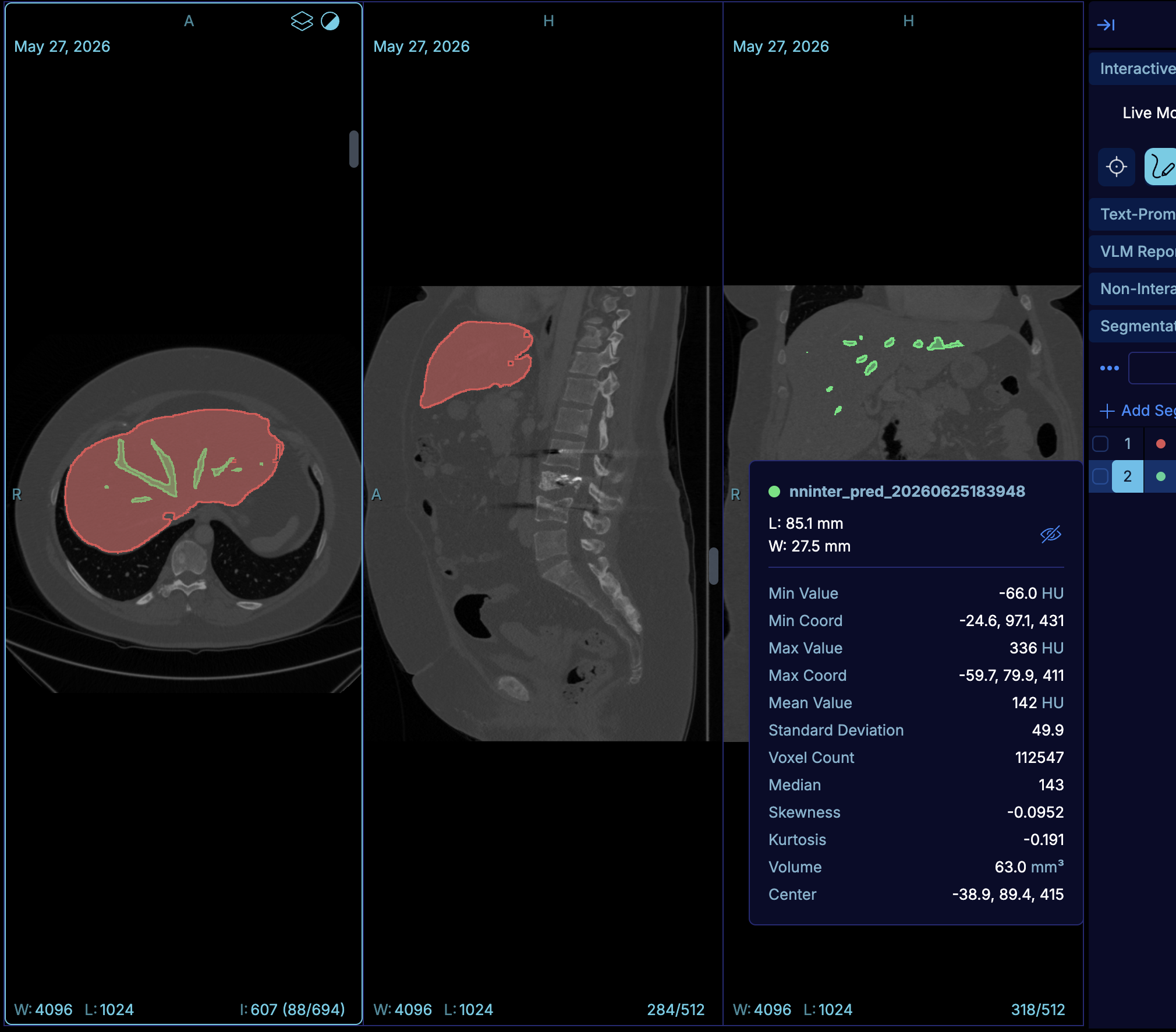
- Overlapping segments in OHIF — Ensure overlapping segmentations work reliably across Stack Viewport + MPR, Volume Viewport, and downstream tools — segmentation statistics and bidirectional measurements.
Several related gaps remain in the broader stack: overlapping segmentations are not always handled reliably across viewport types, DICOM persistence paths are still evolving (PR #5806, #4875), and contour ↔ labelmap conversion is not yet exposed end-to-end in OHIF. This project aims to advance solutions within Cornerstone3D and OHIF toward a more dependable segmentation experience.
For DICOM persistence, standards context, and recommended interchange with research formats (NIfTI), see Background and References.
Objective
-
Understand DICOM-SEG — Review the development and history of DICOM Segmentation (classic binary/fractional SEG, emerging label-map encodings, tooling ecosystem) and document recommended usage for saving, loading, and sharing segmentations in clinical and research workflows (see DICOM-SEG and format interchange).
-
Overlapping segments across OHIF viewports and measurements — In the context of OHIF, ensure overlapping segments work correctly for Stack Viewport + MPR and Volume Viewport, and that this behavior is connected to working segmentation statistics and bidirectional measurements on those segmentations (see Illustrations).
Approach and Plan
- DICOM-SEG review — Summarize standard history (binary SEG → label-map Sup 243), tooling roles (dcmjs, highdicom, dcmqi, etc.), and recommended save/load paths; validate against PR #5806 (background notes).
- Reproduce overlapping-segment issues — Triage reports (e.g. #5453, Cornerstone3D PR #2170) across Stack + MPR and Volume viewports.
- Fix overlapping segment rendering — Investigate segment blending/ordering in Cornerstone3D so multiple overlapping segments render and interact correctly in all target viewport types.
- Connect stats and bidirectional measurements — Verify segmentation statistics (volume, HU stats, voxel count) and bidirectional tool output remain correct when segments overlap and when switching between Stack/MPR and Volume layouts.
Progress and Next Steps
(To be filled in during and after the event)
- …
- …
- …
Illustrations
OHIF MPR layout (Stack + MPR viewports) with overlapping segmentations (red and green), segmentation statistics, and bidirectional measurements:
Background and References
OHIF and Cornerstone3D
| Resource | Notes |
|---|---|
| OHIF Viewer | Web viewer |
| OHIF-AI | OHIF fork with server-side AI (SAM2, nnInteractive, MedSAM2, etc.); project context at University Hospital Bonn |
| Cornerstone3D | Rendering engine |
| Cornerstone3D PR #2170 | Contour ↔ labelmap conversion |
| SLIM Viewer | Microscopy segmentation reference |
| OHIF WSI Microscopy Viewer | WSI viewer (limited segmentation support) |
Related OHIF issues and pull requests
| Item | Relevance |
|---|---|
| #5453 | Segmentation reliability |
| #5849 | Labelmap interpolation (editing; affects exported SEG) |
| #4875 | DICOM label-map support |
| PR #5806 | SEG load/save via per-frame imageLoader; shared dcmjs writer |
| #2833 | Interoperability between highdicom-authored SEGs and OHIF |
DICOM-SEG and format interchange
Reference material for persistence, standards, tooling, and conversion with NIfTI. Intended as background for objective 1 and approach step 1.
Recommended practice
| Goal | Recommended approach | Typical stack |
|---|---|---|
| Clinical / PACS / multi-site sharing | DICOM Segmentation (SOP Class 1.2.840.10008.5.1.4.1.1.66.4) via DICOMweb alongside source images |
OHIF cornerstone-dicom-seg, @cornerstonejs/adapters, dcmjs; offline creation with highdicom or dcmqi |
| In-viewer editing in OHIF | Cornerstone3D labelmap or contour during interaction; export to DICOM SEG on save from referenced volume metadata | @cornerstonejs/adapters, dcmjs (PR #5806: shared dicomWriter.ts, preserved transfer syntax) |
| Research / ML pipelines | NIfTI, NRRD, or Slicer .seg.nrrd internally; DICOM at archive boundaries |
SimpleITK, NiBabel, Slicer; highdicom or pydicom-seg for DICOM export |
| Many non-overlapping segments (100+) | Label-map encodings when available; classic BINARY SEG remains valid but often large/slow | highdicom LABELMAP prototypes; DCMTK/dcmqi; OHIF #5806 (labelmap RLE where supported) |
OHIF loading (PR #5806): Replaces whole-object ArrayBuffer fetch with per-frame imageLoader decoding (Cornerstone3D fix/use-imageLoader-for-seg). Improves load/save for labelmap and compressed bitmap SEGs. Parser type (labelmap vs bitmap) follows SOP Class / pixel layout. Caveat: multi-frame SEGs on non–WADO-RS schemes (dicomfile:, wadouri:) may decode only one frame without error if /frames/N URLs are missing.
Standards landscape
Three related tracks:
-
Segmentation IOD (existing) — Part 3 §C.8.20. Types include
BINARYandFRACTIONAL. Multiple segments historically meant separate binary frame sets (supports overlap; inefficient for many non-overlapping labels). See PW38 DICOM SEG notes. -
Supplement 243 — Label Map Segmentation (Final Text, DICOM 2024d) — Dedicated IOD: pixel values encode segment membership in one array (no overlap per instance). NEMA Sup 243 · overview. Prototypes: highdicom (PW39); DCMTK/dcmqi/Slicer (PW40).
-
LABELMAPSegmentation Type (classic SEG object) — Community encodings on the existing Segmentation IOD (RLE/JPEG-LS/JP2K). Example (TotalSegmentator, PW39): ~385 MB binary vs ~1.9–6.7 MB compressed labelmap.
OHIF: #4875 tracks first-class label-map support. Until broadly available, assume classic DICOM SEG for production interchange; experiment with label-map objects alongside #5806.
DICOM SEG vs NIfTI — why both persist
| DICOM SEG | NIfTI / NRRD / seg.nrrd | |
|---|---|---|
| Strengths | Standard SOP Class; segment metadata; FoR / referenced series; DICOMweb / PACS | Fast I/O; ML ecosystem; simple dense arrays |
| Weaknesses | Size/speed for many-segment binary SEG; viewer variance | Weak clinical metadata; no study linkage without sidecars |
Hub-and-spoke pattern: NIfTI or in-memory labelmaps inside analysis; DICOM SEG at the boundary for VNA/PACS, OHIF, or Slicer.
DICOM ↔ NIfTI interchange
DICOM SEG → NIfTI
Mostly lossless for voxels if geometry and labels are preserved:
- Geometry —
Image Orientation Patient, spacing, andImage Position Patientfrom the referenced series (or per-frame functional groups). NIfTIsform/qformmust match the DICOM patient frame. - Labels — Map Segment Number → NIfTI integer; optional sidecar for Segment Label and coded categories.
- Overlaps — Binary SEG may overlap; one NIfTI labelmap cannot — use per-segment volumes, multi-channel data, or fail explicitly.
- Tools —
highdicom/pydicom-seg(Python); dcmqi / Quantitative Reporting (Slicer); dcmjs / adapters (OHIF).
NIfTI → DICOM SEG
NIfTI does not carry DICOM identity or segment ontology. Required inputs:
| Input | If missing |
|---|---|
| Referenced series (Study/Series/SOP UIDs, Frame of Reference UID) | Must be chosen explicitly — cannot derive from NIfTI alone |
| Spatial alignment with reference grid | Resample NIfTI to reference geometry or document transform |
| Per-segment metadata (number, label, category codes) | Sidecar JSON/CSV or defaults |
| Segmentation Type | BINARY, LABELMAP, or Sup 243 object per overlap/tooling support |
| Overlap policy | Overlapping labels in one array need separate binary segments or another representation |
Suggested pipeline: load reference DICOM → resample labelmap → encode with highdicom or dcmqi → validate in OHIF via DICOMweb. Web-only: dcmjs adapters from Cornerstone labelmaps when viewport metadata includes the reference study.
Package Overview
Project Week pages do not render Mermaid; the diagrams below use plain text so they display on projectweek.na-mic.org.
End-to-end data flow
  Files on disk                    Archive / transport
  ┌──────────────┐                 ┌─────────────────────────────┐
  │ .dcm (SEG)   │◄───────────────►│ PACS / Orthanc / DICOMweb   │
  │ .nii.gz      │    STOW/QIDO    │ QIDO · WADO-RS · STOW-RS    │
  └──────┬───────┘                 └──────────────┬──────────────┘
         │                                        │
         │ read/write                             │ retrieve / store
         ▼                                        ▼
  ┌──────────────────────────────────────────────────────────────────┐
  │                     Conversion & I/O layers                       │
  ├─────────────────────┬──────────────────────┬─────────────────────┤
  │ Python (offline)    │ C++ CLI              │ Browser (OHIF)      │
  │ · pydicom           │ · dcmqi              │ · dicomweb-client   │
  │ · pydicom-seg       │   segimage2itkimage  │ · dcmjs             │
  │ · SimpleITK/NumPy   │   itkimage2segimage  │ · @cornerstonejs/   │
  │ · highdicom         │ · DCMTK (dcmodify)   │   adapters          │
  │                     │ · python-gdcm        │ · cornerstone-dicom-│
  │                     │                      │   seg               │
  └─────────┬───────────┴──────────┬───────────┴──────────┬──────────┘
            │                      │                      │
            └──────────┬───────────┴──────────────────────┘
                       ▼
            ┌─────────────────────┐
            │ ITK / GDCM (C++)    │  ← behind SimpleITK & dcmqi
            └─────────────────────┘
                       │
                       ▼
            ┌─────────────────────┐
            │ OHIF + Cornerstone3D│  labelmap / contour in viewport
            │ core + tools        │  → stats, bidirectional, export
            └─────────────────────┘
Layer stack (who sits on whom)
                    ┌─────────────────────────────────────────┐
                    │           Application layer             │
                    │  OHIF  │  3D Slicer  │  ML / Python     │
                    └────┬──────────┬──────────────┬───────────┘
                         │          │              │
           ┌─────────────┼──────────┼──────────────┼─────────────┐
           ▼             ▼          ▼              ▼             ▼
      dcmjs +      cornerstone-   dcmqi +     highdicom    pydicom-seg
      adapters     dicom-seg      Quant.       (+ pydicom)  (+ SimpleITK)
           │             Reporting      │
           └─────────────┬──────────────┘
                         ▼
              pydicom (Python)  │  dicom-parser (JS, legacy)
                         ▼
              DCMTK / GDCM (C++) — dcmseg, DIMSE
| Package | Language | Role |
|---|---|---|
| pydicom | Python | Low-level DICOM I/O |
| highdicom | Python | SEG/SR/PR builders; label-map prototypes |
| pydicom-seg | Python | Fast multiclass SEG → SimpleITK |
| dcmjs | JavaScript | Browser SEG (de)serialization |
| @cornerstonejs/adapters | TypeScript | Labelmap/contour ↔ DICOM SEG |
| DCMTK / dcmseg | C++ | Reference encoding |
| dcmqi | C++ / CLI | ITK/NIfTI ↔ DICOM SEG (Slicer) |
Validate round-trips (highdicom → OHIF → dcmjs → Slicer) when changing write options (transfer syntax, fragmentMultiframe, labelmap vs bitmap).
DICOM standards and Project Week notes
- DICOM Segmentation (Part 3 §C.8.20)
- Supplement 243 — Label Map Segmentation (2024d)
- PW38 — DICOM Segmentation Optimization
- PW39 — Labelmap segmentations in DICOM
- PW40 — DICOM Label Map (DCMTK/dcmqi)
- OHIF Office Hours 2025-03-06 — label-map discussion (#4875)
- dicom4qi — interoperability testing